Home / Blog / Trademark search cost
How Much Does a Trademark Search Really Cost? (Price Check)
A trademark search can cost $0, or it can cost more than $1,000. Both prices are real, and both can be the right choice. What decides it is what you plan to do with the name.
Short answer: In the US, a trademark search costs $0 if you search the USPTO database yourself, about $25 to $500 for limited or software-based searches, and roughly $500 to $1,000 or more for an attorney-reviewed search. Logos, extra classes and international coverage push the price higher. Treat every figure here as a range, not a quote.
By Imteaz (Galib) Chowdhury · Published November 22, 2026
This guide shows what each level covers, what it can miss, and how to decide how much to spend. It also answers the question most price guides skip: how a trademark search works when you are buying a domain name, not filing a trademark.
This is general information, not legal advice. Prices come from the public pages of the providers named below, as listed in November 2026, and they change often. Check the current page before you rely on a number.
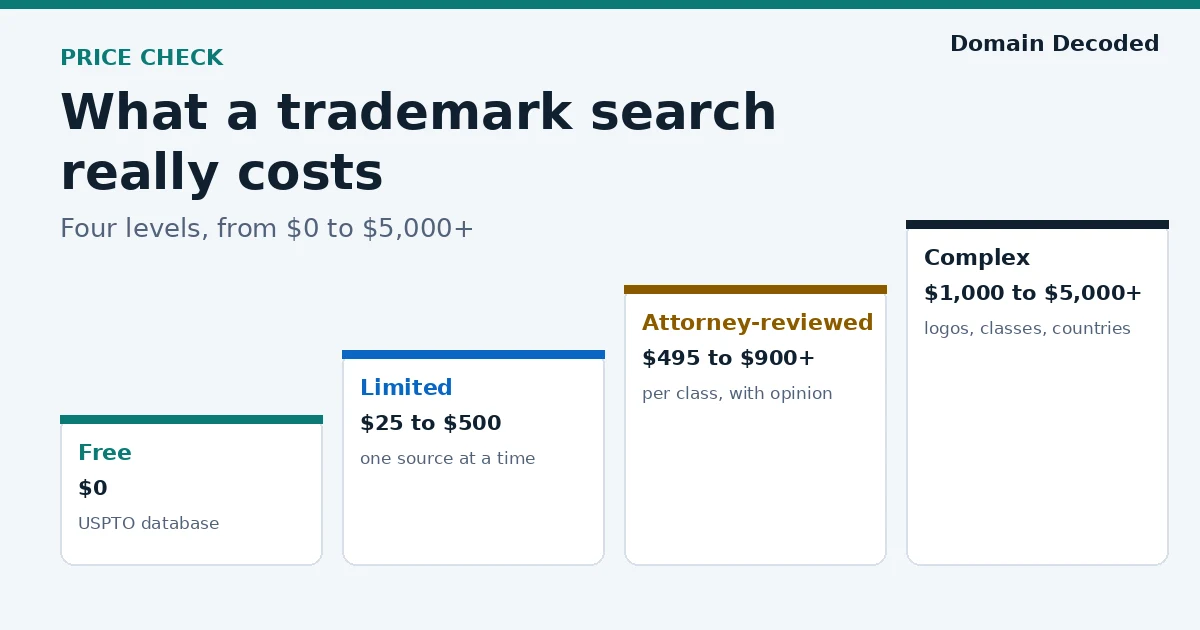
Trademark search cost at a glance
| Search level | Typical cost | What it covers | What it can miss |
|---|---|---|---|
| Free DIY (USPTO database) | $0 | Federal applications and registrations; exact and close matches | State filings, unregistered “common-law” use, sound-alike and meaning-alike marks |
| Limited or single-source search | About $25 to $500 | Often one source at a time, such as federal only or state only | Everything outside that source; usually little or no legal opinion |
| Attorney-reviewed search | About $495 to $900+ per class | Federal, state and common-law sources, plus a written view on conflict risk | Cost rises with logos, more classes and other countries |
| Complex or international search | $1,000 up to $5,000+ | Several countries, design marks, multiple classes | No search can promise approval |
These ranges come from firms that sell searches: American Patent & Trademark Law Center ($25 to $500 overall, with a federal search at $125 and a state search at $100), TradeMark Express ($50 to $900+), Sherinian Law ($495 per class for a word mark, $895 for a design mark), NH Legal ($899 flat, with attorney analysis and a consultation) and EffeMark ($150 to $5,000+). Providers define “search” differently, so the same price can buy very different work.
One caution: these firms sell searches. Their prices are useful, but their advice on how much search you need comes with a sales interest.
What each level of trademark search covers
Free DIY search: $0
The USPTO runs a free public database of federal trademark applications and registrations. For almost everyone, a free trademark lookup is the right first step. It is good at finding exact and near-exact matches in federal records.
Its weakness is what it leaves out. State registrations sit in separate databases. A business that uses a name without registering it can still have common-law rights where it trades. And a name that looks or sounds close to yours, or means the same thing, can cause a conflict even when the spelling is different. One provider, Brandstock, says a free-only search is possible but rarely advisable.
Limited searches: about $25 to $500
Cheaper paid searches usually cover less ground. American Patent & Trademark Law Center, for example, sells a federal search at $125 and a state search at $100 as separate items. IdeaLegal describes its lower tier as a $500 “high-level” search, a basic check of USPTO records.
Before you buy, ask which sources are included and whether a person reviews the results. A $125 federal search answers a smaller question than a $500 search with review, even though both are called a trademark search.
Attorney-reviewed search: about $495 to $900+
This is what people usually mean by trademark clearance. A clearance search checks federal, state and common-law sources, then an attorney explains how risky the conflicts are. Sherinian Law lists $495 per class for a word mark and $895 for a design mark. NH Legal lists a flat $899 that includes attorney analysis and a 30-minute consultation.
The opinion is a big part of what you pay for. The raw report lists similar names. The attorney tells you which ones matter. That judgment is most useful for logos, where deciding whether two designs look alike is not a mechanical task.
Complex searches: $1,000 and up
Wider searches get expensive fast. EffeMark says prices run from $150 to more than $5,000, depending on which components you include. Another guide, from metida, puts typical searches at $300 to $1,000. The providers disagree on the numbers but agree on the reason: cost grows with scope.
What pushes the price up
- Number of classes. Classes group goods and services, and many providers price per class.
- Word mark or logo. The same firm charges $495 for a word mark and $895 for a design mark.
- Where you search. Federal only is cheaper than federal plus state, and both are cheaper than adding other countries.
- Report only, or report plus opinion. Attorney analysis is usually the biggest price jump.
Is a paid trademark search worth it? Do the math
The USPTO lists a base application fee of $350 per class of goods or services. Confirm the current fee on uspto.gov before you plan around it. That fee is generally not refunded if the examiner refuses your application, and a common reason for refusal is likelihood of confusion with an existing mark. That covers marks that look, sound or mean something similar, not only identical ones.
Take a hypothetical case. You plan to file in one class. A $495 attorney-reviewed search costs more than the $350 filing fee it helps protect, so the fee alone does not justify the search. What justifies it is the cost of being forced to change a name you have already built on: the website, the logo, the ads and the domain.
So match the search to what you could lose, not to the filing fee. The next section turns that into a rule for domain buyers.
Trademark search for a domain name
Most trademark search cost guides are written for people filing a trademark. If you are buying a domain, the risk is different, and so is a sensible budget.
Owning a domain does not give you trademark rights. It also does not stop a trademark owner from objecting to how you use the name. In general, disputes turn on whether the name is confusingly similar to someone’s mark and whether it was registered and used in bad faith. Processes such as ICANN’s UDRP, which providers like WIPO administer, and the US Anticybersquatting Consumer Protection Act exist for these cases. For a short take on the risk, see my LinkedIn post The $10 Mistake That Can Cost a Startup $100,000. The details are legal territory, so talk to a trademark attorney before you act on anything serious.
How to check if a domain name is trademarked (free steps)
- Google the name in quotes together with the industry, and check the same name as a social media handle. Look for companies already trading under it, registered or not.
- Search the USPTO database for the exact name, then for spelling variants, plurals and sound-alikes.
- Search WIPO’s Global Brand Database for international records.
- Check the Wayback Machine to see what the domain was used for before.
- Note the industry. The same word in two unrelated industries is a different risk from the same word in yours.
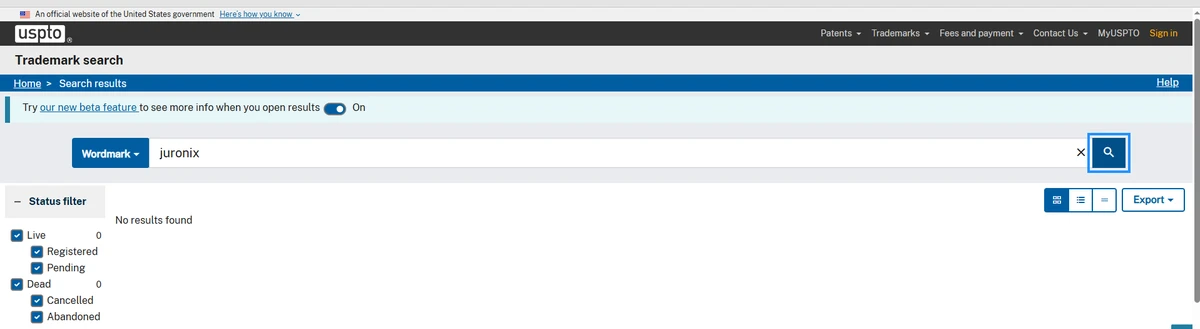
That is the order I follow myself. None of it is quick. A free check rarely makes a problem obvious, so you have to go through each step by hand. That can take two or three days, and closer to a week when you want to feel sure about a name. The full process is on my workflow page, and my playbook on how to check if a domain is trademarked before you buy walks through the free check in plain English. If you are naming a business and not only buying a domain, see my five free checks for business name availability.
I learned to check the hard way. When I started buying domains, a company emailed me to say that a name I had bought was its trademark, and I had to come to an agreement with them. It was a bad experience. I wrote about it briefly in 7 Domain Investing Mistakes I Made.
How much should a domain buyer spend?
This table is my rule of thumb, not legal advice.
| Your situation | Sensible search level |
|---|---|
| Registering a name to hold or test an idea | Free check (the steps above) |
| Buying a name you will build a business on | Free check, then a limited or attorney search before you spend on branding |
| Paying a premium price for a brand name | Attorney-reviewed search for the name in your industry |
| Planning to file a trademark | Comprehensive search for your exact classes |
| Selling a domain | Run the free check and keep the results; showing your checks builds trust with buyers |
I have never paid for a trademark search, because I haven’t needed one so far. Checking is getting harder every year, though, so I expect that to change. No buyer has asked me about trademarks yet, and I don’t give them a reason to: if I am not sure about a name, I usually don’t deal in it. My Juronix.com case study shows what that looks like in practice.
How to spend less on a trademark search
- Run the free checks first. If they already show a clear conflict, you have saved the cost of a paid search.
- Decide your classes before asking for a quote. Many providers price per class, so a vague request leads to a vague price.
- Ask what is included. Get the sources searched, who reviews the results, and whether you receive a written opinion.
- Pay for judgment where it matters. Logos and crowded industries are where an attorney’s view earns its fee.
- Treat a clean result as lower risk, not zero risk. No search guarantees approval or protects you from a later claim. I explain why in Zero Trademark Hits: Still at Risk?
Frequently asked questions
Can I do a trademark search for free?
Yes. The USPTO database is free and covers federal records. It will not show state filings, common-law use or many sound-alikes, so a clear free result lowers the risk without removing it.
How much does it cost to trademark a name?
The search is a separate cost from filing. The USPTO lists a base application fee of $350 per class (confirm the current amount on uspto.gov). Attorney fees, if you use one, come on top.
What is the difference between a trademark search and a trademark clearance search?
A search finds similar marks. A clearance search, as providers use the term, adds an analysis of how likely your name is to conflict, often written by an attorney. That analysis is why clearance costs more.
Do I need a trademark search before buying a domain name?
Registrars will not ask you to, but it is inexpensive protection. A conflicting mark can force you to give up a name after you have built on it. At minimum, run the free checks in this guide.
How do I search trademarks outside the US?
Start with WIPO’s Global Brand Database, which covers records from many countries. For a country it does not include, use that country’s trademark office.
Conclusion
A trademark search costs anywhere from nothing to well over $1,000, and the price follows scope: how many classes, whether it is a logo, which countries, and whether an attorney reviews it. Start with the free checks every time. Pay for more only when the cost of being wrong, the rebrand, the lost domain or the refused filing, is bigger than the cost of the search.
If you are weighing a specific domain, try my free Domain Appraisal Tool to score it first, then run the checks above before you commit. Still choosing the name itself? My ranking of the best books on naming a business may help.
Since I haven’t paid for a search myself yet, I would like to hear from people who have. If you have, share what it cost and what you learned. Send me a message.
Sources: prices and statements come from the public pages of American Patent & Trademark Law Center, TradeMark Express, Sherinian Law, NH Legal, EffeMark, IdeaLegal, metida and Brandstock, as listed in November 2026. This is general information, not legal advice. Please read the disclaimer.
Checking a domain before you commit?
I run a trademark and history check on one domain and send you a short written report. The Domain Risk Check Report is $39 and arrives within 3 business days of payment.
Keep reading
How to Check If a Domain Is Trademarked Before You Buy
A free 15-minute check in plain English, and how to read what you find.
Read the full post Playbook · Full ReadHow to Check If a Business Name Is Available (Beyond the Domain)
Five free checks in the right order: state registry, trademark, DBA, domain and social handles.
Read the full postChecking a domain before you buy it?
Score it free in a minute, or order a written report for $39.
Get new domain insights by email
One short email when a new article or case study goes up. No spam, and you can unsubscribe at any time.